About 286 minutes
The Iroquois Book of Rites — A Reader’s Guide
Social Conditions
65,701 recorded words. 4 minutes difference from this book's estimate.
View Gutenberg source #8567
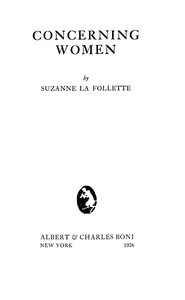
This digital edition of Concerning Women — A Reader’s Guide is described by source-level measurements including 66,504 words, 4 hr 50 min estimated reading time, and 7 detected text sections.
The text analysis averages about 33.2 words per sentence, while the detected sections provide another way to judge how the source is divided.
Project Gutenberg metadata also associates the work with “Women -- Social and moral questions,” connecting these edition facts with the source record’s subject description.
Explore this collection
These alternatives are selected using recorded categories and estimated reading time.
About 286 minutes
Social Conditions
65,701 recorded words. 4 minutes difference from this book's estimate.
View Gutenberg source #8567About 283 minutes
Social Conditions
64,895 recorded words. 7 minutes difference from this book's estimate.
View Gutenberg source #75467About 300 minutes
Social Conditions
68,956 recorded words. 10 minutes difference from this book's estimate.
View Gutenberg source #14798Search stored excerpts and compare books → Choose by your preferences →
Choices use stored catalog measurements. Estimates vary with reading speed. A shared category is a catalog label, not a claim that two books have the same argument or literary quality.
Search reads excerpt text stored with this catalog and links to its associated Gutenberg record. The connection is stored in the site database; this tool does not recheck that every excerpt is word-for-word identical to that external record. Excerpt search does not cover every chapter and does not verify historical publication dates.
Catalog snapshot checked: 2026-09-25. Coverage: 100 public books, 100 available source excerpts.
Calculated from edition completeness, EPUB availability, text structure and catalogue metadata. Not a user rating.
Total of 100 points, scaled to a 2.5-5.0 range. Editions with an empty description or a missing EPUB file are not scored.
Public-domain source text
The source text is kept in the dedicated reader, separate from this catalogue record and its commentary.
Suzanne La Follette opens Concerning Women with a provocative premise: books about women as a class are themselves evidence that women are not yet free. She draws a parallel between sex-based and class-based domination, noting that a dominant group tends to see itself as humanity and the other as a convenience. This framing sets the tone for a work that treats women's status not as a natural order but as a social arrangement sustained by tradition and force.
La Follette builds her case through sustained analogies between sex domination and class domination. She writes that a dominant class, like an aristocracy, comes to believe the existing order is the only possible one and imposes that belief on those beneath it. This rhetorical strategy allows her to discuss women's condition without relying on biological determinism. Instead, she treats gender hierarchy as a political structure, subject to the same critique as any unjust social system. The analogy recurs throughout the text, reinforcing her central claim that women's subordination is not inevitable but historically contingent.
In later chapters, La Follette turns to concrete data. She cites a 1922 Women's Bureau bulletin on industrial training, showing that public vocational schools in nine states offered women little beyond dressmaking and millinery, while men received instruction in machine-shop practice, tool-making, and sheet-metal work. She notes that these schools were funded by taxpayers of both sexes, yet their curricula were "designed for men." The disparity, she argues, reveals the force of traditional prejudice: even when women entered new industries during World War I, training institutions failed to adapt. Her use of government reports grounds her argument in verifiable fact, moving from abstract principle to institutional critique.
La Follette's prose is precise and unadorned, favoring terms like "disabilities," "conditions," and "status" over emotional appeals. She avoids sentimental language about women's nature, instead employing the vocabulary of political philosophy: "coercion," "domination," "class." This choice reflects her intellectual lineage—she was a noted individualist and later an editor of The Freeman. Her sentences are often long and layered, building arguments through accumulation rather than epigram. The effect is a tone of reasoned analysis, inviting the reader to follow a chain of logic rather than be swayed by rhetoric.
The available excerpts cover only the opening chapter and a portion of the economic analysis. The full work includes chapters on marriage, women's economic position, and signs of promise, but these are not represented here. Consequently, it is impossible to assess La Follette's treatment of marriage as an institution or her proposed solutions. Readers should note that the excerpts reveal her method—analogy, data, and philosophical argument—but not the full arc of her thesis. The book's subtitle, if any, is not given, and the table of contents suggests a broad scope that the excerpts only partially illustrate.
Readers approaching Concerning Women should attend to La Follette's consistent use of analogy and her reliance on empirical evidence. Her voice is that of a polemicist who values logic over sentiment, and her arguments are built from both principle and fact. The excerpts suggest a work that is as much a critique of social institutions as a call for reform, grounded in the belief that equality requires not just legal change but a transformation of ingrained assumptions.
Reading La Follette’s 1926 words, I felt that ache of unfinished business—how the same battles echo. It made me think of The family and its members — Key Ideas to Explore, sitting nearby on my shelf, unread for years. Some questions about home and belonging just wait patiently, like old friends. I suppose we return to them when we’re ready.
Your answers remain private and are stored only in this browser.









