
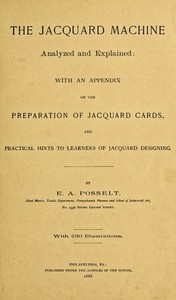
The Jacquard Machine Analyzed and Explained by E. A. Posselt
Published in 1893, this book is a detailed technical guide. There's no plot in the traditional sense, no characters to follow. Instead, the 'story' is the machine itself. E.A. Posselt, an expert in textile machinery, acts as your patient guide. He systematically breaks down the Jacquard loom's anatomy. He starts with the core idea: a chain of punched cards, where each hole or its absence gives an instruction. He then explains how this card 'program' is read by a grid of needles and hooks. Finally, he shows how those movements lift specific threads to create the pattern in the fabric.
Why You Should Read It
You should read it because it makes you see a common object—fabric—in a completely new light. Posselt’s clear explanations (supported by fantastic diagrams) demystify what seems like magic. You realize this isn't just a loom; it's a physical computer. The 'if-then' logic of the punched cards is the direct ancestor of the software running on your phone right now. It connects the dots between the ornate tapestries of the 19th century and the digital age in a way that’s genuinely thrilling. It’s a powerful reminder that major leaps in technology often come from unexpected places.
Final Verdict
This is a niche but brilliant read for specific readers. It's perfect for history buffs who love the Industrial Revolution, tech enthusiasts curious about analog computing, or makers and engineers who appreciate elegant mechanical design. It’s not a breezy novel—it requires some focus—but the payoff is a profound understanding of a foundational technology. If you've ever wondered how complex patterns got into fabric before printers, or if you just love a good 'how-it-works' puzzle, this century-old manual will absolutely fascinate you.
No rights are reserved for this publication. Use this text in your own projects freely.
Margaret Davis
7 months agoI've gone through the entire material twice now, and the chapter on advanced strategies offers insights I haven't seen elsewhere. Simple, effective, and authoritative – what else could you ask for?
David Johnson
9 months agoSolid information without the usual fluff.
Emily Rodriguez
6 months agoAs a professional in this niche, the language used is precise without being overly academic or confusing. This is a solid reference for both beginners and experts.
Donald Brown
1 month agoMy first impression was quite positive because it addresses the common misconceptions in a very professional manner. Truly a masterpiece of digital educational material.




James Garcia
1 year agoA sophisticated analysis that fills a gap in the literature.