
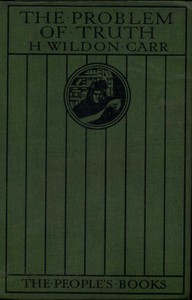
The Problem of Truth by Herbert Wildon Carr
Published in 1915, Herbert Wildon Carr's The Problem of Truth isn't a novel with a plot in the traditional sense. Think of it more as an intellectual journey. Carr sets out to examine one of philosophy's oldest puzzles: the nature of truth itself. He starts by looking at the common-sense view that truth is a simple match between our ideas and the real world. Then, he methodically shows why he finds that view unsatisfying.
The Story
The 'story' here is the argument. Carr walks you through different theories of truth, like the correspondence theory (truth is what matches reality) and the coherence theory (truth is what fits consistently within a system of beliefs). His main goal is to present and defend his own view, which is a form of 'voluntarism' or 'activism.' For Carr, truth isn't a passive discovery; it's something we achieve. It's tied to action, purpose, and the active organizing power of our minds. He believes we don't just find truth lying around—we make it true through our engagement with the world and our drive to understand it in a coherent, useful way.
Why You Should Read It
I picked this up expecting a dry academic lecture, but Carr's voice is surprisingly direct and personal. He writes like he's trying to convince you, not just lecture you. What stuck with me was his idea that truth is alive. It's not a fossil in a museum case. It changes and grows as our understanding and purposes evolve. This book made me question my own lazy assumptions. I'd never really thought about truth as an active process before. While some sections require slow, careful reading, the payoff is a genuinely different perspective. It connects big philosophical ideas to how we actually live and think every day.
Final Verdict
This book is perfect for curious readers who enjoy deep dives into big ideas. It's great if you've dabbled in philosophy through more popular writers and want to try a primary source that's still very readable. It's also a fascinating historical snapshot of early 20th-century thought. I wouldn't recommend it as your very first philosophy book, but if you're willing to put in a little mental work, Carr is a rewarding guide. You'll finish it looking at every 'fact' you encounter with a new, more questioning eye.
This is a copyright-free edition. It is now common property for all to enjoy.
Mason Jackson
1 year agoWithout a doubt, the plot twists are genuinely surprising. I couldn't put it down.
Donna Miller
1 year agoI didn't expect much, but the depth of research presented here is truly commendable. This story will stay with me.
Michelle Sanchez
1 year agoSimply put, the narrative structure is incredibly compelling. Absolutely essential reading.