About 73 minutes
Chicago's Black Traffic in White Girls — Themes and Context
Social Conditions
16,722 recorded words. 2 minutes difference from this book's estimate.
View Gutenberg source #31615
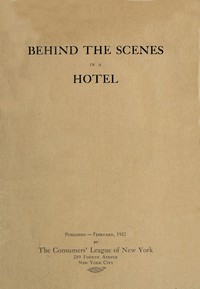
Before opening Behind the Scenes in a Hotel — Text and Context, the edition data offers a quick orientation: 17,217 words, 1 hr 15 min estimated reading time, and 6 detected text sections.
The text analysis averages about 18.4 words per sentence, while the detected sections provide another way to judge how the source is divided.
Project Gutenberg metadata also associates the work with “Women -- Employment -- New York (State),” connecting these edition facts with the source record’s subject description.
Explore this collection
These alternatives are selected using recorded categories and estimated reading time.
About 73 minutes
Social Conditions
16,722 recorded words. 2 minutes difference from this book's estimate.
View Gutenberg source #31615About 78 minutes
Social Conditions
17,822 recorded words. 3 minutes difference from this book's estimate.
View Gutenberg source #15126About 79 minutes
Social Conditions
17,976 recorded words. 4 minutes difference from this book's estimate.
View Gutenberg source #29Search stored excerpts and compare books → Choose by your preferences →
Choices use stored catalog measurements. Estimates vary with reading speed. A shared category is a catalog label, not a claim that two books have the same argument or literary quality.
Search reads excerpt text stored with this catalog and links to its associated Gutenberg record. The connection is stored in the site database; this tool does not recheck that every excerpt is word-for-word identical to that external record. Excerpt search does not cover every chapter and does not verify historical publication dates.
Catalog snapshot checked: 2026-09-25. Coverage: 100 public books, 100 available source excerpts.
Calculated from edition completeness, EPUB availability, text structure and catalogue metadata. Not a user rating.
Total of 100 points, scaled to a 2.5-5.0 range. Editions with an empty description or a missing EPUB file are not scored.
Public-domain source text
The source text is kept in the dedicated reader, separate from this catalogue record and its commentary.
The Consumers' League of New York City opens this 1922 report by situating the hotel industry as the fifth largest in the United States, a claim drawn from the 35th Convention of the New York Hotel Association. The report traces the industry's rapid expansion from small inns to colossal urban hotels, noting that the largest in New York advertised 2,200 rooms and baths. This growth, enabled by elevators and fireproof materials, set the stage for a labor system the League set out to examine.
The investigation focuses on women workers—chambermaids, bathmaids, waitresses, and pantry workers—and uses a method of applying for jobs to collect wage data. The excerpts present tables that break down wages by whether lodging or meals are provided, revealing that in no case did the cash wages meet the minimum standard of $16.50 per week set by the District of Columbia's Minimum Wage Board.
The report's core evidence is a series of wage tables that categorize workers by whether they receive cash only, cash plus lodging, cash plus meals, or full board and lodging. For chambermaids and bathmaids living in, wages ranged from under $5 to under $10 per week, with over half earning between $6 and $7. The League compares these figures to the District of Columbia's minimum of $16.50, deducting estimated costs for board ($9) or meals ($6) to argue that even the highest wages fell short. For example, workers receiving three meals but no lodging needed at least $10.50 per week, yet none reached that amount. The tables are precise, listing the number of hotels paying each wage bracket, and they consistently show that the majority of hotels paid between $9 and $13 for cash-only wages.
The report addresses tipping as the most unstandardized part of hotel workers' earnings. It notes that tips depend on the whim of the public and general prosperity, making them impossible to standardize. The League points out the incongruity of tipping in an industry whose function is service, implying that gratuities effectively become a direct payment from patrons to workers, bypassing the wage system. This section underscores how tipping obscures the true cost of labor and leaves workers vulnerable to fluctuations in customer generosity. The report does not quantify tips but uses their unpredictability to argue that reliance on them undermines any effort to establish a fair wage.
Among the positions examined, pantry workers are identified as a skilled class with higher wages, yet they have no access to tips. In one hotel, a pantry worker received $50 per month with board and lodging ($11.53 per week), and in another $55 per month ($12.29 per week). Kitchen workers in two hotels earned $30 per month regardless of living arrangements. These examples show that even the highest wages for women in hotels barely approached a living wage. The report's method of applying for jobs allows it to capture actual offers rather than stated policies, lending credibility to the wage data. The contrast between pantry workers' skill and their lack of tips highlights the arbitrary nature of compensation in the industry.
The Consumers' League conducted its investigation by having agents apply for jobs in hotels across New York State, including New York City and first- and second-class cities. This approach yielded firsthand wage offers and details about living conditions. The report focuses on women workers, reflecting the League's broader concern with women's employment. The excerpts do not reveal the number of hotels surveyed or the exact time frame, but the tables cover 46 hotels for cash wages and 29 for living-in chambermaids. The investigation is limited to wages and does not explore other working conditions such as hours, workload, or health risks. The League's stance is evident in its comparisons to the District of Columbia's minimum wage, which it treats as a benchmark for a self-supporting woman.
Readers should approach this report as a snapshot of hotel labor conditions in the early 1920s, grounded in empirical wage data rather than anecdote. The tables and job-application method provide a concrete basis for understanding the economic realities faced by women workers. The report does not offer solutions or advocacy beyond presenting the facts, but its systematic documentation makes it a valuable primary source for studying labor history and the early consumer movement.
Reading about those women quietly tallying their wages in 1922, I found myself thinking of the cold stone shelters in that other book, the ones carved into cliffs for protection. Both felt like hidden architectures of survival, unspoken and sturdy, holding lives that the world rarely paused to notice. Cliff Castles and Cave Dwellings of Europe — Themes and Context lingered in my mind like an echo of that same patient endurance.
Save your reaction, strongest insight, and memorable passage.









