About 75 minutes
Behind the Scenes in a Hotel — Text and Context
Social Conditions
17,217 recorded words. 2 minutes difference from this book's estimate.
View Gutenberg source #65443
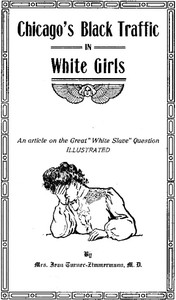
Before opening Chicago's Black Traffic in White Girls — Themes and Context, the edition data offers a quick orientation: 16,722 words, 1 hr 13 min estimated reading time, and 3 detected text sections.
The text analysis averages about 31.6 words per sentence, while the detected sections provide another way to judge how the source is divided.
Project Gutenberg metadata also associates the work with “Prostitution -- Illinois -- Chicago,” connecting these edition facts with the source record’s subject description.
Explore this collection
These alternatives are selected using recorded categories and estimated reading time.
About 75 minutes
Social Conditions
17,217 recorded words. 2 minutes difference from this book's estimate.
View Gutenberg source #65443About 78 minutes
Social Conditions
17,822 recorded words. 5 minutes difference from this book's estimate.
View Gutenberg source #15126About 79 minutes
Social Conditions
17,976 recorded words. 6 minutes difference from this book's estimate.
View Gutenberg source #29Search stored excerpts and compare books → Choose by your preferences →
Choices use stored catalog measurements. Estimates vary with reading speed. A shared category is a catalog label, not a claim that two books have the same argument or literary quality.
Search reads excerpt text stored with this catalog and links to its associated Gutenberg record. The connection is stored in the site database; this tool does not recheck that every excerpt is word-for-word identical to that external record. Excerpt search does not cover every chapter and does not verify historical publication dates.
Catalog snapshot checked: 2026-09-25. Coverage: 100 public books, 100 available source excerpts.
Calculated from edition completeness, EPUB availability, text structure and catalogue metadata. Not a user rating.
Total of 100 points, scaled to a 2.5-5.0 range. Editions with an empty description or a missing EPUB file are not scored.
Public-domain source text
The source text is kept in the dedicated reader, separate from this catalogue record and its commentary.
Jean Turner-Zimmermann's Chicago's Black Traffic in White Girls opens with a foreword that establishes a dual purpose: to expose a 'vicious, thoroughly organized white-slave traffic' and to ground that exposure in seven years of firsthand work in Chicago's slum districts. The author, a physician and president of the Chicago Rescue Mission, explicitly distinguishes this eighth edition from earlier versions by prioritizing 'descriptions and actual facts' over anecdotal 'incidents' drawn from newspapers. This methodological claim shapes the pamphlet's voice—alternating between the clinical authority of statistics and the visceral immediacy of case narratives.
The text repeatedly insists on its authenticity. Turner-Zimmermann states that 'all incidents, references and statistics (as far as possible) herein given are strictly authentic,' and she credits sources such as United States Attorney Sims and reformer Rev. Ernest A. Bell. This framing is not merely prefatory; it permeates the pamphlet's structure. The author includes flashlight photographs of a 'sound-proof dungeon cell' and a 'heavy steel screen' used in brothels, treating visual evidence as corroboration. Yet the excerpts also reveal a tension: the claim to factual rigor coexists with a moral vocabulary that labels a brothel proprietor a 'fiend in human form' and invokes Dante's Inferno to describe a 'White Slave mart.' The reader observes how the author moves between the language of social science and the rhetoric of reformist outrage.
One extended case study—the story of 'G.,' a 'little Italian mother who spoke no word of English'—illustrates the pamphlet's narrative technique. The account follows G. from a poorhouse birth to sweatshop labor at $2.50 per week, the death of her baby, and her eventual seduction by a man who offers bread. Turner-Zimmermann writes in a compressed, present-tense style: 'G. took the bread and fed her children and to-day up on the top floor of the tenement in Plymouth Court, again deserted and hungry and helpless, she cries and prays.' The shift from past to present tense heightens immediacy, while details such as the specific wage and location lend documentary weight. The case is not presented as unique but as representative of a systemic pattern—a method that recurs throughout the excerpts.
The pamphlet's rhythm alternates between broad statistical claims and concentrated, almost cinematic descriptions. Early passages cite 'United States Attorney Sims, Rev. Ernest A. Bell and others' to establish the scope of the traffic. Later, the narrative narrows to a single, harrowing image: a 'blind passage-way between 114 and 116 Custom House Place' leading to a 'windowless, sound-proof' dungeon where victims were allegedly 'broken in' by force. The prose slows to describe the cell's dimensions ('about 7x10 feet') and the 'agonized shrieks' that 'beat' against its walls. This juxtaposition of dry measurement with emotional language creates a distinctive rhythm—one that moves the reader from the general to the particular, from the documented to the felt.
Readers approaching this pamphlet should attend to its hybrid form: part reformist tract, part sociological report, part moral melodrama. Turner-Zimmermann's insistence on authenticity invites scrutiny of how evidence is marshaled and where rhetorical flourish overtakes documentation. The excerpts offer a window into early twentieth-century reform rhetoric and its strategies for making systemic injustice visible—and urgent.
That old editorial voice stays with me—how Jean Turner-Zimmermann let statistics give way to raw stories, numbers softening into faces. There’s a quiet ache in that documentary honesty. This book about ancient Ohio mounds carries a similar weight, I think, a patient wondering about what the ground remembers. It lingered with me the way a half-finished sentence does. The Problem of the Ohio Mounds — Story, Setting & Ideas feels like an echo of that same careful gaze.
A brief reflection can help important ideas stay with you longer.









