About 112 minutes
Home Problems from a New Standpoint — Key Ideas to Explore
Society Culture
25,750 recorded words. 16 minutes difference from this book's estimate.
View Gutenberg source #49669
The catalog record for Don't marry — Story, Setting & Ideas provides practical reading context through 21,934 words, 1 hr 36 min estimated reading time, and 13 detected text sections.
The text analysis averages about 18.8 words per sentence, while the detected sections provide another way to judge how the source is divided.
Project Gutenberg metadata also associates the work with “Marriage,” connecting these edition facts with the source record’s subject description.
Explore this collection
These alternatives are selected using recorded categories and estimated reading time.
About 112 minutes
Society Culture
25,750 recorded words. 16 minutes difference from this book's estimate.
View Gutenberg source #49669About 115 minutes
Society Culture
26,368 recorded words. 19 minutes difference from this book's estimate.
View Gutenberg source #28187About 127 minutes
Society Culture
29,191 recorded words. 31 minutes difference from this book's estimate.
View Gutenberg source #53958Search stored excerpts and compare books → Choose by your preferences →
Choices use stored catalog measurements. Estimates vary with reading speed. A shared category is a catalog label, not a claim that two books have the same argument or literary quality.
Search reads excerpt text stored with this catalog and links to its associated Gutenberg record. The connection is stored in the site database; this tool does not recheck that every excerpt is word-for-word identical to that external record. Excerpt search does not cover every chapter and does not verify historical publication dates.
Catalog snapshot checked: 2026-09-25. Coverage: 100 public books, 100 available source excerpts.
Calculated from edition completeness, EPUB availability, text structure and catalogue metadata. Not a user rating.
Total of 100 points, scaled to a 2.5-5.0 range. Editions with an empty description or a missing EPUB file are not scored.
Public-domain source text
The source text is kept in the dedicated reader, separate from this catalogue record and its commentary.
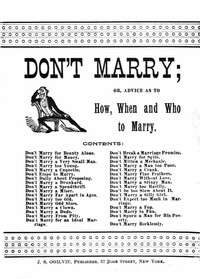
James W. Donovan's Don't Marry opens with a striking table of contents built entirely from prohibitions: 'Don't Marry for Beauty Alone,' 'Don't Marry a Very Small Man,' 'Don't Marry a Drunkard.' This list of thirty-four 'Don't' commands immediately establishes the book's direct, cautionary tone. Rather than a romantic treatise, it reads as a practical handbook, warning against common pitfalls in courtship and marriage. The author's voice is blunt and worldly, urging readers to consider character, health, and financial stability over fleeting attractions.
The book's organizing principle is a series of negative commands, each chapter addressing a specific type of unsuitable partner or marriage scenario. The table of contents lists topics such as 'Don't Marry a Coquette,' 'Don't Marry a Spendthrift,' and 'Don't Marry Far Apart in Ages.' This format suggests a systematic approach to marital advice, covering physical traits, personality flaws, and social circumstances. The repetition of 'Don't' creates a rhythmic, almost legalistic framework, emphasizing the risks of poor choices.
Donovan's advice is grounded in practical concerns. He warns against marrying for money or beauty alone, but also cautions against poverty, stinginess, and recklessness. In the excerpt on poverty, he argues that 'prosperity is the parent of friends; misfortune is the fire by which they are tried,' and cites examples of successful men who started poor, such as Franklin, Greeley, and Lincoln. He advises patience, noting that 'few are rich under fifty, seldom under sixty' in America. The tone is pragmatic, urging readers to look beyond surface appearances and consider long-term compatibility.
Donovan employs a direct, sometimes aphoristic style. He uses maxims like 'Life is so short to quarrel and make up in; they who quarrel may never make up.' His advice is often framed as common sense, appealing to the reader's self-interest. He warns against 'the color-blindness of lovers: they never use but one color—rose color—till a few weeks after the wedding.' This metaphor captures his skepticism toward romantic idealism. The author's voice is authoritative yet conversational, addressing both men and women as rational agents capable of making informed choices.
The book reflects late 19th-century American social norms. Donovan assumes a heterosexual, middle-class audience, with advice tailored to women choosing husbands and men seeking wives. He emphasizes the importance of family consultation and public ceremony, advising against elopement or secrecy: 'Let the world know by open dealing that you have married above any secrecy.' He also touches on geographic preferences, asking whether a woman is 'ready to attend a cattle ranch and brave the frontier' or prefers city life. These details situate the advice within a specific historical moment, where marriage was a practical arrangement as much as a romantic union.
For a first reading, the excerpts reveal a book that is more systematic than its title might suggest. The table of contents provides a clear roadmap, while the sample chapters show Donovan's blend of moralizing and practical counsel. Readers should note the author's reliance on examples from history and common experience, and his tendency to frame advice as warnings. The tone is earnest but not sentimental, aiming to equip readers with criteria for evaluating potential partners. The book's structure encourages dipping into relevant chapters rather than reading straight through.
Donovan's Don't Marry is best approached as a period piece of practical ethics, offering a window into 19th-century attitudes toward marriage. Readers may find the advice dated in specifics but resonant in its emphasis on careful consideration. The book's strength lies in its directness and its refusal to romanticize marital decisions. For those interested in historical advice literature, it provides a clear example of the genre's conventions and concerns.
There’s a certain sadness in Donovan’s blunt “Don’ts,” a recognition of how rarely hearts and practicalities align. It reminds me of those old city photographs, families packed into tenements, their aspirations so quiet you have to lean in to hear them. That same ache surfaces in The Battle with the Slum — A Reader’s Guide, where the struggle isn’t for romance, but simply for a steadier, cleaner tomorrow. Both books hold that wistful afterthought.
Save your reaction, strongest insight, and memorable passage.









