
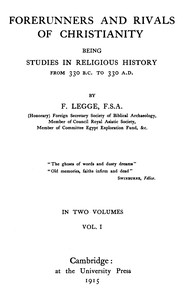
Forerunners and rivals of Christianity : being studies in religious history…
Let's be clear: this isn't a novel. There's no main character or plot twist in the traditional sense. Instead, Francis Legge, writing over a century ago, acts as your guide through the crowded religious landscape of the ancient Mediterranean and Near East.
The Story
The 'story' Legge tells is the story of ideas in competition. He doesn't start with Bethlehem. He starts centuries earlier, introducing you to the spiritual ferment that filled the air before and during Christianity's rise. You'll meet the devotees of Mithras, a popular soldier's god with his own communion meal. You'll encounter the complex, secretive world of Gnosticism, which offered a different path to salvation. Legge traces the threads of Greek philosophy, Persian beliefs, and Egyptian mysteries, showing how they swirled together in the Roman Empire. The central drama is how the early Christian movement navigated this world—what it rejected, what it argued against, and what ideas might have subtly shaped its own message as it grew from a small sect into a major force.
Why You Should Read It
I love this book because it completely changes the backdrop. Reading it, you stop seeing early Christianity as appearing on a blank stage. You see it stepping into a spotlight already shared by other performers. It makes the whole era feel more alive and more real. The debates, the letters of Paul, the decisions of early church councils—they all make more sense when you understand what they were arguing against. Legge shows that religious ideas were traded, debated, and remixed just like goods along the Silk Road. It demystifies history in the best way, showing the human process behind what can seem like fixed, eternal truths.
Final Verdict
This is a classic for a reason, but know what you're getting into. It's perfect for curious readers and history buffs who want to look 'behind the curtain' of religious history. It's great for anyone who's asked, 'Where did that idea in Christianity come from?' Because it was written in 1915, some of its conclusions are outdated—modern scholars have new evidence and different views. But that's okay! Think of Legge as a passionate, knowledgeable old professor giving you the grand tour. Read it for the big picture and the fascinating questions it raises, then use it as a springboard to explore more recent books on the subject. It's a foundational text that's still engaging over a century later.
Lisa Sanchez
1 year agoAmazing book.
Kevin Perez
7 months agoVery interesting perspective.
Elijah Davis
3 months agoThanks for the recommendation.





Dorothy King
1 year agoI stumbled upon this title and the storytelling feels authentic and emotionally grounded. Exceeded all my expectations.