About 812 minutes
A History of Matrimonial Institutions, Vol. 1 of 3 — A Closer Reading
Society Culture
186,715 recorded words. 405 minutes difference from this book's estimate.
View Gutenberg source #49107
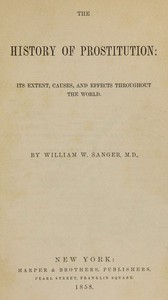
The History of Prostitution: Its Extent, Causes, and Effects throughout the World — Reading Companion can be approached with a clearer sense of reading commitment from its source measurements: 279,710 words, 20 hr 17 min estimated reading time, and 36 detected text sections.
The text analysis averages about 23.6 words per sentence, while the detected sections provide another way to judge how the source is divided.
Project Gutenberg metadata also associates the work with “Prostitution,” connecting these edition facts with the source record’s subject description.
Explore this collection
These alternatives are selected using recorded categories and estimated reading time.
About 812 minutes
Society Culture
186,715 recorded words. 405 minutes difference from this book's estimate.
View Gutenberg source #49107About 598 minutes
Society Culture
137,351 recorded words. 619 minutes difference from this book's estimate.
View Gutenberg source #50752About 448 minutes
Society Culture
102,836 recorded words. 769 minutes difference from this book's estimate.
View Gutenberg source #37897Search stored excerpts and compare books → Choose by your preferences →
Choices use stored catalog measurements. Estimates vary with reading speed. A shared category is a catalog label, not a claim that two books have the same argument or literary quality.
Search reads excerpt text stored with this catalog and links to its associated Gutenberg record. The connection is stored in the site database; this tool does not recheck that every excerpt is word-for-word identical to that external record. Excerpt search does not cover every chapter and does not verify historical publication dates.
Catalog snapshot checked: 2026-09-25. Coverage: 100 public books, 100 available source excerpts.
Calculated from edition completeness, EPUB availability, text structure and catalogue metadata. Not a user rating.
Total of 100 points, scaled to a 2.5-5.0 range. Editions with an empty description or a missing EPUB file are not scored.
Public-domain source text
The source text is kept in the dedicated reader, separate from this catalogue record and its commentary.
William W. Sanger's The History of Prostitution (1858) originated as an official report to the Governors of the Alms-House of New York City. The work's dual identity—part municipal investigation, part global survey—shapes its structure and rhetoric. Sanger, a physician on Blackwell's Island, frames prostitution as a social ill demanding reform, yet his method relies heavily on historical anecdotes and travel narratives rather than systematic data. The excerpts reveal a tension between the catalog subject "Prostitution" and the actual content, which often focuses on colonial violence and clerical hypocrisy in Mexico and South America.
The book's title page announces it as "Being an Official Report to the Board of Alms-House Governors of the City of New York," yet the dedication and advertisement emphasize a broader ambition. Sanger thanks the governors for their "conception" of the investigation and claims his work will "induce future generations to remember with pride that the first blow struck in the Western World at the gigantic vice Prostitution was aimed" by them. This local origin contrasts with the global scope of the chapters. The catalog subject "Prostitution" is thus filtered through a 19th-century reformist lens, where moral condemnation and historical anecdote substitute for empirical analysis. Readers expecting a focused study of prostitution in New York will instead encounter a wide-ranging narrative that uses foreign examples to argue for domestic intervention.
A substantial portion of the excerpted text describes the Spanish conquest of Mexico. Sanger cites Bernal de Díaz to illustrate how Spanish soldiers "branded" women prisoners and divided them for sexual use. He then extends this critique to the clergy, quoting Thomas Page's 1677 travelogue. Page describes a prior's cell "richly tapestried" with feathers and silk, where the friar sang "a sonnet in praise of a certain lady." Page concludes that many friars and Jesuits traveled to the Americas out of "libertinage rather than love of preaching the Gospel." These passages, while vivid, are only tangentially about prostitution. They serve Sanger's argument that colonial exploitation and religious hypocrisy created conditions for sexual vice, but they also reveal his reliance on secondary sources and his tendency to equate all non-marital sexual activity with prostitution.
Sanger's method raises questions about evidence. The excerpts contain no statistical tables or case studies from New York, despite the report's official origin. Instead, he uses a single anecdote from Bernal de Díaz to generalize about "Spanish warfare and conquest in every clime." Similarly, Thomas Page's account of a gambling scene in a convent is presented as proof of clerical corruption. The catalog subject "Prostitution" is thus stretched to encompass any form of sexual immorality, as defined by 19th-century standards. Sanger's voice is consistently moralistic: he decries "lust, avarice, and cruelty" and praises the Alms-House governors for striking a "blow" against vice. Readers should approach the work as a period document that reveals more about its author's reformist agenda than about the actual history of prostitution.
Sanger's History of Prostitution is best read as a primary source on mid-19th-century American reform rhetoric. Its catalog subject belies a text that spends more time on colonial Mexico than on New York City. The excerpts show a writer assembling a moral argument from travel literature and historical chronicles, often conflating different forms of sexual exploitation. For modern readers, the work offers insight into how 19th-century reformers constructed narratives of vice to justify intervention, but it should not be mistaken for an objective history.
That rainy afternoon, Sanger’s colonial chronicles unsettled me—how conquest wore clerical robes. I set him down and drifted, almost by accident, toward The American Nations, Vol. I. Or, Outlines of a National History of the Ancient and Modern Nations of North and South America — Reading Notes. Its older, quieter maps seemed to hold the same shadows, only less confessed. I stayed there until the window darkened.
Your answers remain private and are stored only in this browser.









