About 202 minutes
Modern marriage and how to bear it — Inside the Classic
Social Conditions
46,312 recorded words. 4 minutes difference from this book's estimate.
View Gutenberg source #31529
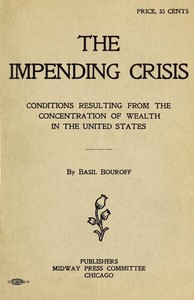
Before opening The impending crisis — Reading Notes, the edition data offers a quick orientation: 45,352 words, 3 hr 18 min estimated reading time, and 14 detected text sections.
The text analysis averages about 19.6 words per sentence, while the detected sections provide another way to judge how the source is divided.
Project Gutenberg metadata also associates the work with “Wealth,” connecting these edition facts with the source record’s subject description.
Explore this collection
These alternatives are selected using recorded categories and estimated reading time.
About 202 minutes
Social Conditions
46,312 recorded words. 4 minutes difference from this book's estimate.
View Gutenberg source #31529About 206 minutes
Social Conditions
47,335 recorded words. 8 minutes difference from this book's estimate.
View Gutenberg source #43631About 209 minutes
Social Conditions
47,846 recorded words. 11 minutes difference from this book's estimate.
View Gutenberg source #578Search stored excerpts and compare books → Choose by your preferences →
Choices use stored catalog measurements. Estimates vary with reading speed. A shared category is a catalog label, not a claim that two books have the same argument or literary quality.
Search reads excerpt text stored with this catalog and links to its associated Gutenberg record. The connection is stored in the site database; this tool does not recheck that every excerpt is word-for-word identical to that external record. Excerpt search does not cover every chapter and does not verify historical publication dates.
Catalog snapshot checked: 2026-09-25. Coverage: 100 public books, 100 available source excerpts.
Calculated from edition completeness, EPUB availability, text structure and catalogue metadata. Not a user rating.
Total of 100 points, scaled to a 2.5-5.0 range. Editions with an empty description or a missing EPUB file are not scored.
Public-domain source text
The source text is kept in the dedicated reader, separate from this catalogue record and its commentary.
Basil A. Bouroff opens The Impending Crisis with a stark declaration: this is not a novel, but a work grounded in the Eleventh Census and other statistical reports. His preface frames the book as a diagnosis of a 'diseased situation' in which the majority of Americans are becoming tenants rather than owners. Bouroff's language is clinical—he speaks of 'dividogenesure' (a term he coins for the pressure that forces debtors to labor for creditors) and of property loss as a process that begins with the loss of rights. The excerpts show a writer who treats economic data as evidence of a national emergency, not as dry numbers.
Bouroff repeatedly uses medical metaphors to describe the economy. In the preface he calls the work a 'general diagnosis of the diseased situation' and refers to 'curing the disease of the national organism.' This is not casual language; it shapes how readers are meant to receive the statistics that follow. The author positions himself as a physician examining a patient, and the nation as a body in crisis. The word 'crisis' in the title is thus not just a label but a clinical term. Bouroff's choice to open with this framing suggests he expects resistance—he anticipates that readers 'inclined to make discounts in established truths' will be surprised by his conclusions. The preface functions as a warning: the evidence will be uncomfortable, but ignoring it is no longer possible.
The excerpts from the chapter on mortgaged farms show Bouroff's method in detail. He takes a single Census Bureau bulletin and extracts a narrative: of 4,767,179 farming families, only 65.92 percent own the farms they cultivate, and of those owners, 28.22 percent are in debt. He then calculates that the average debt of $1,085,995,960 bears interest at 7.07 percent, which he calls a drain on 'labor energy.' His key move is to equate mortgagors with tenants: 'a mortgagor, according to the degree of his indebtedness, is an economic slave.' The term 'dividogenesure' appears here as the mechanism by which a property owner becomes a debtor who must prioritize the creditor's interests. Bouroff does not simply report numbers; he interprets them as evidence of a transformation from independence to dependence.
Bouroff invents the word 'dividogenesure' to describe the condition of a property owner who has mortgaged his land. He defines it as the obligation to 'divide the results of his labor between the lender and himself.' The term is not found in standard economic texts of the period; it is Bouroff's own contribution to the debate on wealth concentration. In the excerpts, he uses it repeatedly, almost as a technical term, to argue that debt is not a temporary inconvenience but a permanent loss of economic freedom. The word appears in a section heading: 'LOSS OF RIGHTS PRECEDES LOSS OF PROPERTY.' Bouroff's diction here is deliberate: he wants to create a vocabulary that captures what he sees as a new form of servitude. Readers should note that this neologism is central to his argument, and its absence from later economic discourse may reflect how his work was received.
Bouroff organizes his chapters around specific Census bulletins, moving from tenant families to mortgagor families. The excerpts show a clear progression: first he establishes the number of propertyless tenants, then he shows how property owners fall into that category through debt. He writes, 'the loss of the rights to property always precedes the actual loss of property itself.' This logical chain is reinforced by the typography of the original text, which uses headings and spacing to emphasize key points. The statistical tables are not reproduced in the excerpts, but Bouroff's prose treats them as the foundation of his argument. He is careful to cite his sources—'Extra Bulletin No. 98 of the United States Census, 1890'—and to explain what each number means. This method gives his work the appearance of objectivity, even as his language ('economic slave,' 'disease') reveals a passionate commitment to reform.
Bouroff's The Impending Crisis is best read as a primary document of Progressive-era economic thought. Its value lies not in the accuracy of its predictions but in the way it translates statistical data into moral argument. Readers interested in the history of economic rhetoric will find Bouroff's neologisms and medical metaphors revealing. Those seeking a data-driven analysis should note that the author's conclusions are shaped by his framework of diagnosis and crisis. The book is a snapshot of how one early twentieth-century writer used the tools of social science to sound an alarm about wealth concentration.
Flipping through Bouroff's census notes, I kept returning to his strange word, dividogenesure—how debt quietly hollows out a life. It made me remember a battered copy of The Bitter Cry of the Children — Reading Companion, and its own quiet witness to hunger. Both felt less like arguments than confessions, chronicling how systems erode the flesh they depend on.
Answer a few questions and save a private reflection on this device.









