About 209 minutes
Down with the Cities! — Story, Setting & Ideas
Social Conditions
47,846 recorded words. 3 minutes difference from this book's estimate.
View Gutenberg source #578
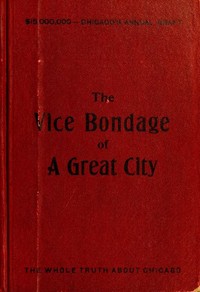
The catalog record for The Vice Bondage of a Great City; or, the Wickedest City in the World — Inside the Classic provides practical reading context through 47,335 words, 3 hr 26 min estimated reading time, and 6 detected text sections.
The text analysis averages about 17.1 words per sentence, while the detected sections provide another way to judge how the source is divided.
Project Gutenberg metadata also associates the work with “Prostitution -- Illinois -- Chicago,” connecting these edition facts with the source record’s subject description.
Explore this collection
These alternatives are selected using recorded categories and estimated reading time.
About 209 minutes
Social Conditions
47,846 recorded words. 3 minutes difference from this book's estimate.
View Gutenberg source #578About 202 minutes
Social Conditions
46,312 recorded words. 4 minutes difference from this book's estimate.
View Gutenberg source #31529About 198 minutes
Social Conditions
45,352 recorded words. 8 minutes difference from this book's estimate.
View Gutenberg source #50424Search stored excerpts and compare books → Choose by your preferences →
Choices use stored catalog measurements. Estimates vary with reading speed. A shared category is a catalog label, not a claim that two books have the same argument or literary quality.
Search reads excerpt text stored with this catalog and links to its associated Gutenberg record. The connection is stored in the site database; this tool does not recheck that every excerpt is word-for-word identical to that external record. Excerpt search does not cover every chapter and does not verify historical publication dates.
Catalog snapshot checked: 2026-09-25. Coverage: 100 public books, 100 available source excerpts.
Calculated from edition completeness, EPUB availability, text structure and catalogue metadata. Not a user rating.
Total of 100 points, scaled to a 2.5-5.0 range. Editions with an empty description or a missing EPUB file are not scored.
Public-domain source text
The source text is kept in the dedicated reader, separate from this catalogue record and its commentary.
Robert O. Harland opens The Vice Bondage of a Great City with a subtitle that declares Chicago the “Wickedest City in the World,” setting a tone of moral outrage that pervades the entire work. The book is structured as a factual recital, not fiction, and Harland repeatedly insists on the veracity of his claims. He describes a “Vice Trust” that operates like a business, with a directorate, agents (policemen), and a systematic flow of graft from brothels to “men higher up.” The language is direct and accusatory, often using terms like “damnable work” and “hellish profits” to condemn the system.
Harland frames organized vice as a trust, borrowing the language of early twentieth-century antitrust discourse. He writes of a “Vice Trust” with a “grafting directorate” that accepts money and ensures vice “lives and flourishes.” This metaphor extends to the mechanism of collection: policemen gather graft, pass it to superior officers, who take a percentage and send the bulk upward. Harland even specifies that high officials sometimes hire “private and debased citizens” to collect payments, distancing themselves from direct involvement. The trust is portrayed as a self-perpetuating system, with roots that survive even when the “axe of the Civil Service Commission” hacks at its trunk. Harland’s choice to use the term “trust” links his exposé to contemporary concerns about monopolies, suggesting that vice is not merely a moral failing but an organized economic exploitation.
Harland’s diction is saturated with moral absolutism. He describes the vice trade as “sin, crime and graft,” and refers to the “Temple of Crime, Vice and Graft” that will be “rebuilded” after reform efforts wane. His prose relies on stark binaries: the “Army of Sin” versus the forces of decency, the “Scarlet Woman” versus the innocent girl or boy. The book’s preface warns that the “storm will blow over” and the “root of evil” must be killed. This language is designed to create urgency and to inoculate the reader against complacency. Harland does not allow for nuance; the system is evil, the reformers are righteous, and the only remedy is to “hound out” corrupt politics. The repeated use of “souls” and “damnation” underscores the religious framework through which he interprets urban corruption.
Rather than relying solely on his own assertions, Harland incorporates testimony from a “prominent attorney” and a “well known criminal lawyer” to corroborate his claims. The attorney describes a “regular tax” levied on establishments, collected by plainclothes men who pass it up the chain. He notes that no one in the district will talk for fear of being “run out.” The criminal lawyer recounts a visit to the Empire Hotel, where the proprietress explained a police raid as a warning for not paying protection money. These embedded voices lend an air of investigative journalism to the text. Harland presents them as independent verification, though the excerpts do not reveal whether he conducted his own interviews or relied on newspaper reports. The effect is to create a mosaic of insider knowledge, with the author as the synthesizer of damning evidence.
A striking feature of Harland’s argument is his insistence that reform is temporary. He writes that the “town is closed” only for the moment, and that vice lords are “waiting until the brooms of the municipal house-cleaners are stacked away.” This metaphor of housecleaning suggests a cyclical pattern: periodic crackdowns disrupt vice but do not eradicate it. Harland warns that the “foundation is intact” and the “Temple of Crime” will be rebuilt. This rhetoric serves a dual purpose: it justifies the book’s existence even after recent police discharges, and it frames the problem as systemic rather than episodic. By predicting relapse, Harland positions his exposé as a permanent warning, not a news item. The reader is left with the sense that only fundamental political change—the destruction of “corrupt and ruling politics”—can break the cycle.
Harland’s book is best approached as a primary document of Progressive-era muckraking, where moral fervor and investigative detail intertwine. Readers should note how the author’s diction—terms like “vice trust,” “graft masters,” and “enslaved police”—shapes the argument as much as the facts he presents. The excerpts suggest a work that is less a neutral report than a call to action, aimed at creating “public and saving opinion.” Pay attention to the way Harland uses embedded testimony and predictive warnings to build his case, and consider how the book’s structure reflects its rhetorical goals.
Reading Harland’s fury at Chicago’s corruption, I kept thinking how his moral certainty felt almost childlike. That earnest belief in exposure as remedy—it lingered with me. Later, I found a quieter echo in The Pivot of Civilization — Text and Context, where reform’s limits aren’t shouted, just traced in gentler, private edges. Both left me somehow homesick for a simpler faith in fixing things.
Save your reaction, strongest insight, and memorable passage.









