About 165 minutes
The boy and his gang — Inside the Classic
Society Culture
37,878 recorded words. 29 minutes difference from this book's estimate.
View Gutenberg source #57927
The source record for Tragedies of the White Slave — Key Ideas to Explore measures this digital text at 44,428 words, 3 hr 14 min estimated reading time, and 5 detected text sections.
The text analysis averages about 15.3 words per sentence, while the detected sections provide another way to judge how the source is divided.
Project Gutenberg metadata also associates the work with “Prostitution -- Illinois -- Chicago,” connecting these edition facts with the source record’s subject description.
Explore this collection
These alternatives are selected using recorded categories and estimated reading time.
About 165 minutes
Society Culture
37,878 recorded words. 29 minutes difference from this book's estimate.
View Gutenberg source #57927About 160 minutes
Society Culture
36,657 recorded words. 34 minutes difference from this book's estimate.
View Gutenberg source #24712About 247 minutes
Society Culture
56,778 recorded words. 53 minutes difference from this book's estimate.
View Gutenberg source #45741Search stored excerpts and compare books → Choose by your preferences →
Choices use stored catalog measurements. Estimates vary with reading speed. A shared category is a catalog label, not a claim that two books have the same argument or literary quality.
Search reads excerpt text stored with this catalog and links to its associated Gutenberg record. The connection is stored in the site database; this tool does not recheck that every excerpt is word-for-word identical to that external record. Excerpt search does not cover every chapter and does not verify historical publication dates.
Catalog snapshot checked: 2026-09-25. Coverage: 100 public books, 100 available source excerpts.
Calculated from edition completeness, EPUB availability, text structure and catalogue metadata. Not a user rating.
Total of 100 points, scaled to a 2.5-5.0 range. Editions with an empty description or a missing EPUB file are not scored.
Public-domain source text
The source text is kept in the dedicated reader, separate from this catalogue record and its commentary.
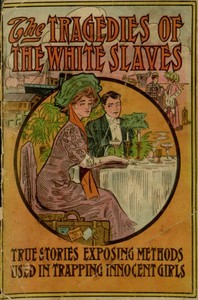
H. M. Lytle's Tragedies of the White Slave (1909) opens with a startling statistic: 5,000 young girls are sacrificed annually in Chicago alone, a figure attributed to the Chicago Law and Order League and Assistant State's Attorney Clifford G. Roe. The book presents itself as a collection of true stories, each illustrating a different method used to lure innocent victims. The table of contents lists ten tragedies, including 'The Tragedy of the Want Ad' and 'The Tragedy of the Little Immigrant,' signaling a systematic approach to exposing the mechanisms of the white slave trade.
The foreword establishes a framework of numerical authority, citing police estimates of 68,000 women leading a 'nameless existence' in Chicago. Lytle invokes Dr. L. Blake Baldwin's average of four years for a woman's life in brothels, attributing early death to drink, cigarette smoking, and 'dope.' These statistics are presented without citation of methodology, functioning instead as rhetorical devices to underscore the scale of the crisis. The author positions himself as a 'Special Investigator for the Metropolitan Press,' lending an air of journalistic credibility to the sensational accounts that follow.
Ella Gingles' narrative, occupying the latter half of the book, provides a first-person account of entrapment. She describes being lured by a woman named Miss Barrett, who offered work in a lace store. Gingles recalls that Miss Barrett 'petted and fondled me' and spoke of fine clothes and wealthy men. The turning point comes on 'that awful night, January 4, 1909,' when Gingles is drugged, cut, and assaulted. Her testimony includes specific details: being tied to a bathtub, threatened with a knife, and forced to become a slave for six months at $25 down and $5 per day. The account is graphic and visceral, emphasizing her physical resistance: 'I kicked and fought and fought and kicked.'
The table of contents reveals a deliberate taxonomy of victimization: each chapter targets a specific vulnerability—immigrant status, theatrical ambition, economic need, or domestic service. The 'Tragedy of the Want Ad' and 'Tragedy of the Theatrical Agency' point to the exploitation of job seekers. The 'Tragedy of the Maternity Home' suggests a particularly cruel ruse. This cataloging of methods implies a systemic critique, though the excerpts do not reveal whether Lytle offers solutions beyond exposure. The inclusion of 'Ella Gingles' Own Story' as a chapter title indicates a shift from third-person reportage to direct testimony, heightening the emotional impact.
Readers should approach Tragedies of the White Slave as a document of its era, blending reformist zeal with sensationalism. The book's reliance on police estimates and legal figures invites scrutiny of its sources, while the graphic testimony of Ella Gingles offers a rare, if mediated, voice from the margins. Lytle's work is best understood as a primary source for early twentieth-century moral panic and the rhetoric of the white slavery scare.
That old Lytle book stayed with me—not for the horrors, though those linger too, but for how carefully each girl’s story was pieced together from forgotten records. It made me think of The Wanderings and Homes of Manuscripts — Edition Insights, and how every trace we leave has a journey of its own, quietly waiting to be noticed again.
Save your reaction, strongest insight, and memorable passage.









