About 52 minutes
Marriage Enrichment Retreats: Story of a Quaker Project — Reading Notes
Society Culture
11,800 recorded words. 18 minutes difference from this book's estimate.
View Gutenberg source #29899
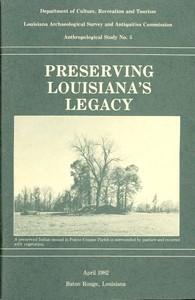
The catalog record for Preserving Louisiana's Legacy: Everyone Can Help — Inside the Classic provides practical reading context through 7,715 words, 34 min estimated reading time, and 1 detected text section.
The text analysis averages about 20.0 words per sentence, while the detected sections provide another way to judge how the source is divided.
Project Gutenberg metadata also associates the work with “Indians of North America -- Louisiana -- Antiquities -- Collection and preservation,” connecting these edition facts with the source record’s subject description.
Explore this collection
These alternatives are selected using recorded categories and estimated reading time.
About 52 minutes
Society Culture
11,800 recorded words. 18 minutes difference from this book's estimate.
View Gutenberg source #29899About 60 minutes
Society Culture
13,781 recorded words. 26 minutes difference from this book's estimate.
View Gutenberg source #31369About 96 minutes
Society Culture
21,934 recorded words. 62 minutes difference from this book's estimate.
View Gutenberg source #53368Search stored excerpts and compare books → Choose by your preferences →
Choices use stored catalog measurements. Estimates vary with reading speed. A shared category is a catalog label, not a claim that two books have the same argument or literary quality.
Search reads excerpt text stored with this catalog and links to its associated Gutenberg record. The connection is stored in the site database; this tool does not recheck that every excerpt is word-for-word identical to that external record. Excerpt search does not cover every chapter and does not verify historical publication dates.
Catalog snapshot checked: 2026-09-25. Coverage: 100 public books, 100 available source excerpts.
Calculated from edition completeness, EPUB availability, text structure and catalogue metadata. Not a user rating.
Total of 100 points, scaled to a 2.5-5.0 range. Editions with an empty description or a missing EPUB file are not scored.
Public-domain source text
The source text is kept in the dedicated reader, separate from this catalogue record and its commentary.
The booklet opens with a concrete example: Big Oak Island, a prehistoric Tchefuncte village in New Orleans East dating to 500 BC, preserved by a developer leasing the site to the National Park Service for one dollar a year. This anecdote immediately establishes the work's central argument—that preservation depends on cooperation between private landowners, businesses, and government. The author, Nancy W. Hawkins, outreach coordinator for the Division of Archaeology, writes in a direct, instructional tone, addressing readers as potential site discoverers and stewards.
The text is structured as a practical manual rather than a scholarly monograph. It explains archaeological methods in general terms, then details threats to sites and specific actions anyone can take, from reporting finds to tax-deductible donations. The excerpts show a consistent focus on actionable steps, supported by concrete examples like the soybean field where continued plowing at the same depth minimizes further disturbance.
The booklet emphasizes that most archaeological sites are first noticed by ordinary people, not professionals. A key tool is the site reporting form included in the center of the original print edition. The instructions are precise: plot the location on a U.S.G.S. topographic quad map, photograph the site, and fill out the form without digging. This emphasis on non-invasive recording reflects the work's core message—that preservation begins with observation, not excavation.
The author repeatedly stresses that amateurs should not attempt to excavate. Instead, they should alert the Division of Archaeology, which can evaluate the site before any ground disturbance occurs. The text thus positions the reader as a partner in a systematic process, not a lone discoverer. The language is procedural, listing steps in a logical order, and avoids romanticizing the act of finding artifacts.
A substantial portion of the excerpts addresses private landowners, who control most archaeological sites in Louisiana. The text outlines several preservation strategies: leaving a site under natural vegetation to camouflage and limit access; continuing plowing at the same depth if a site is already in a cultivated field; or placing the site on the Registry of State Cultural Resource Landmarks, which creates a formal agreement with the state.
Financial incentives are described in detail. One landowner paid half the excavation cost, claimed it as a tax deduction, then donated the artifacts and deducted their value—effectively recovering the entire expense. Federal tax incentives also apply to donating a site or granting an easement, which can qualify as a charitable contribution for income, estate, and gift tax purposes. These passages ground the preservation appeal in economic reality, making it concrete for property owners.
The booklet situates individual actions within a broader framework of state and federal programs. The Louisiana Archaeological Survey and Antiquities Commission, listed in the front matter, oversees the Registry and coordinates preservation efforts. The text references laws such as La. R.S. 41:1601-1613, which authorize the publication itself. This legal context reinforces that preservation is not merely voluntary but supported by statutory structures.
Industry involvement is illustrated by the New Orleans East developer, who leased Big Oak Island to the Jean Lafitte National Historical Park. The developer's statement—that leaving areas untouched may not be the most profitable plan but could be priceless in the future—exemplifies the kind of public-private partnership the booklet advocates. The text thus moves from individual to institutional scales, showing how each sector can contribute.
The final excerpted section, titled "YOU CAN HELP," directly addresses the reader. It acknowledges that most people do not know how to report a site and provides the reporting form as a solution. The tone is encouraging but restrained: the booklet does not claim that every reader will make a major discovery, but rather that consistent, small actions—reporting, not digging, leaving sites undisturbed—collectively protect heritage.
The text avoids hyperbole. It notes that a site in a cultivated field "probably will not suffer significantly" from continued plowing, and that a landowner who cannot protect a site should give advance warning. These qualified statements reflect the author's expertise: she presents realistic outcomes, not guarantees. The booklet thus functions as a practical guide, not a motivational speech, and its credibility rests on this measured approach.
This booklet is best read as a reference for specific actions rather than a continuous narrative. The excerpts suggest that readers will gain most by focusing on the procedural sections—site reporting, landowner options, tax incentives—and by noting the concrete examples that illustrate each point. The author's voice is that of a state agency outreach coordinator: informative, precise, and oriented toward real-world application. For a first reading, pay attention to how the text balances legal and financial details with accessible instructions, and how it consistently directs the reader toward the Division of Archaeology as the central resource.
That rainy afternoon, I kept thinking how the guide made preservation feel like a neighborly duty, not a museum chore—small hands doing quiet, important work. It reminded me, oddly, of another book about loyalty and muddied shoes, where belonging meant looking after your own. I set one down and picked up The boy and his gang — Inside the Classic, and the rain just kept falling.
Build a private reading journal entry for this title.









