About 84 minutes
New Discoveries at Jamestown Site of the First Successful English Settlement in America — Key Ideas to Explore
Customs Everyday Life
19,229 recorded words. 5 minutes difference from this book's estimate.
View Gutenberg source #16277
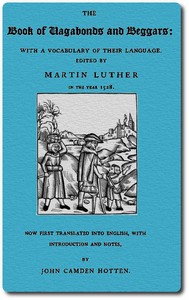
Before opening The Book of Vagabonds and Beggars, with a Vocabulary of Their Language — Text and Context, the edition data offers a quick orientation: 17,964 words, 1 hr 19 min estimated reading time, and 30 detected text sections.
The text analysis averages about 17.3 words per sentence, while the detected sections provide another way to judge how the source is divided.
Project Gutenberg metadata also associates the work with “Begging -- Germany,” connecting these edition facts with the source record’s subject description.
Explore this collection
These alternatives are selected using recorded categories and estimated reading time.
About 84 minutes
Customs Everyday Life
19,229 recorded words. 5 minutes difference from this book's estimate.
View Gutenberg source #16277About 57 minutes
Customs Everyday Life
13,070 recorded words. 22 minutes difference from this book's estimate.
View Gutenberg source #38086About 123 minutes
Customs Everyday Life
28,196 recorded words. 44 minutes difference from this book's estimate.
View Gutenberg source #28365Search stored excerpts and compare books → Choose by your preferences →
Choices use stored catalog measurements. Estimates vary with reading speed. A shared category is a catalog label, not a claim that two books have the same argument or literary quality.
Search reads excerpt text stored with this catalog and links to its associated Gutenberg record. The connection is stored in the site database; this tool does not recheck that every excerpt is word-for-word identical to that external record. Excerpt search does not cover every chapter and does not verify historical publication dates.
Catalog snapshot checked: 2026-09-25. Coverage: 100 public books, 100 available source excerpts.
Calculated from edition completeness, EPUB availability, text structure and catalogue metadata. Not a user rating.
Total of 100 points, scaled to a 2.5-5.0 range. Editions with an empty description or a missing EPUB file are not scored.
Public-domain source text
The source text is kept in the dedicated reader, separate from this catalogue record and its commentary.
The Liber Vagatorum, first published in 1528 and here translated by John Camden Hotten, is a curious hybrid: part rogue's catalogue, part moral warning, and part linguistic record. Martin Luther's involvement—he wrote a preface and oversaw the edition—lends the book an unexpected authority, though its contents are far from pious. The work systematically classifies beggars by their specialized deceptions, from the Schleppers who feign priestly ordination to the Gickisses who fake blindness. Each chapter ends with a blunt Conclusio, often advising the reader to give nothing. Hotten's translation, published in 1860, preserves the original's antique flavor while adding extensive notes, making this an early contribution to both criminology and slang lexicography.
That Martin Luther—the great Reformer—would edit a book detailing the frauds of vagabonds may seem incongruous. Yet Luther saw the Liber Vagatorum as a practical tool for exposing sin and protecting the pious from exploitation. In his preface, he frames the work as a mirror to society's ills, not unlike his own polemics against indulgences. The book's structure, with its methodical classification of beggar types and their tricks, mirrors the systematic approach Luther applied to theology. Hotten notes that Luther wrote several popular pieces during the Reformation, and this edition fits that pattern: a vernacular text aimed at a broad audience, using plain language to unmask deception. The Reformer's endorsement gave the book a moral weight it might otherwise have lacked, transforming a rogue's manual into a cautionary tract.
One of the book's most enduring features is its glossary of Rotwelsch, the secret language of German vagabonds. Terms like GEFLÖSSELT (drowned) and SONNENBOSS (brothel) reveal a coded world where words themselves are tools of survival. The vocabulary is not merely a list; it is embedded in the narratives of trickery. For instance, the Schleppers claim they will not return to a village because they would be geflösselt, using insider jargon to bolster their fabricated stories. Hotten, a noted bibliographer and slang collector, recognized the linguistic value of this material. His translation preserves the original German terms alongside English equivalents, allowing readers to see how language both conceals and reveals. The vocabulary offers a rare window into the argot of a marginalized community, predating modern slang dictionaries by centuries.
The beggars described in this book are consummate performers. The Schwanfelders strip naked in public, shivering theatrically to evoke pity, while the Gickisses tie bloody cotton over their eyes and spin tales of being robbed and blinded in a forest. These performances are carefully scripted: the Schleppers invent detailed biographies, naming specific villages and families, and even claim to have been consecrated for an altar. The book's Exempla—short cautionary tales—underscore the gap between appearance and reality. One tells of a false priest named Mansuetus who invited farmers to his first mass in St. Gallen, only to be discovered later in a brothel. The text insists that such deceptions are not isolated but systematic, exploiting the piety and isolation of rural communities. The book thus serves as an early ethnography of performance, documenting how poverty and fraud intersect in the creation of believable personas.
Readers approaching this edition should treat it as a historical document rather than a straightforward exposé. Hotten's notes and introduction provide essential context, but the core text remains a product of its time—judgmental, coarse, and fascinated by the very rogues it condemns. Pay attention to the Conclusio at the end of each chapter: these terse verdicts reveal the book's practical purpose as a guide for the wary. The vocabulary section rewards careful study, offering a linguistic key to a world that has largely vanished. Above all, read with an awareness that this is a translation of a translation, filtered through multiple hands and centuries.
There are days when the old vocabularies feel like a kind of intimacy, and I find myself circling back to The Book of Vagabonds and Beggars, the way one revisits a half-remembered street. It sits oddly next to the quiet of The Harim and the Purdah: Studies of Oriental Women — Reading Companion, though. Both are maps of lives lived just behind a curtain, spoken in borrowed words. I keep them near, more for the ache than the information.
Save your reaction, strongest insight, and memorable passage.