About 79 minutes
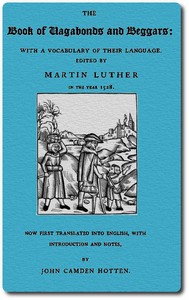
The Book of Vagabonds and Beggars, with a Vocabulary of Their Language — Text and Context
Customs Everyday Life
17,964 recorded words. 22 minutes difference from this book's estimate.
View Gutenberg source #46287
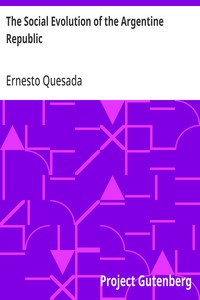
The Social Evolution of the Argentine Republic — Reading Notes can be approached with a clearer sense of reading commitment from its source measurements: 13,070 words, 57 min estimated reading time, and 2 detected text sections.
The text analysis averages about 27.2 words per sentence, while the detected sections provide another way to judge how the source is divided.
Project Gutenberg metadata also associates the work with “Argentina -- Social conditions,” connecting these edition facts with the source record’s subject description.
Explore this collection
These alternatives are selected using recorded categories and estimated reading time.
About 79 minutes
Customs Everyday Life
17,964 recorded words. 22 minutes difference from this book's estimate.
View Gutenberg source #46287About 84 minutes
Customs Everyday Life
19,229 recorded words. 27 minutes difference from this book's estimate.
View Gutenberg source #16277About 123 minutes
Customs Everyday Life
28,196 recorded words. 66 minutes difference from this book's estimate.
View Gutenberg source #28365Search stored excerpts and compare books → Choose by your preferences →
Choices use stored catalog measurements. Estimates vary with reading speed. A shared category is a catalog label, not a claim that two books have the same argument or literary quality.
Search reads excerpt text stored with this catalog and links to its associated Gutenberg record. The connection is stored in the site database; this tool does not recheck that every excerpt is word-for-word identical to that external record. Excerpt search does not cover every chapter and does not verify historical publication dates.
Catalog snapshot checked: 2026-09-25. Coverage: 100 public books, 100 available source excerpts.
Calculated from edition completeness, EPUB availability, text structure and catalogue metadata. Not a user rating.
Total of 100 points, scaled to a 2.5-5.0 range. Editions with an empty description or a missing EPUB file are not scored.
Public-domain source text
The source text is kept in the dedicated reader, separate from this catalogue record and its commentary.
Ernesto Quesada, Argentina's attorney-general and a university professor, wrote this 1911 monograph for an American audience, originally appearing in The Annals of the American Academy of Political and Social Science. The text opens with a frank admission of the difficulty: condensing 'several centuries of the history of a nation like the Argentine Republic' into a few pages. Quesada's voice is that of a statesman-scholar, blending legal precision with sociological analysis. He does not simply narrate events; he identifies the 'forces that have determined the development' of the country, framing the entire account as a study in social evolution.
Quesada devotes considerable attention to the nineteenth-century struggle between the centralist party (based in Buenos Aires) and the federalist party (rooted in the provinces). He argues that the centralists, despite their 'oppression and patronage,' gave the country 'the cohesion of a nation' and 'solved the difficulty traditional to our national organization.' The federalist triumph after Caseros, however, brought about a 'complete democratization' of the country. Quesada's key claim is that this political shift also bridged 'the chasm that separated the social classes of the capital city from those of the provincial districts.' He credits the federalist victory with destroying 'prejudices of blood, of caste and fortune' and establishing a society where 'every man was the heir of his own labor.' The gaucho, the rural cowboy figure, emerges as a central agent in this transformation, entering public life through the army and civic movements.
One of Quesada's more striking observations concerns the minimal foreign presence in Argentina before the mid-nineteenth century. He notes that 'the characteristic of this intermediate epoch is the very slight introduction of the foreign element.' The English formed the largest group, but their commerce 'did not become great' because it was 'never reinforced by that of other nations.' Quesada also mentions a small infusion of German blood from prisoners taken at the Battle of Ituzaingo, though he dismisses it as 'a very subordinate factor.' This scarcity of immigration stands in sharp contrast to the later period, which Quesada identifies as being 'guided and carried forward by two factors, immigration and foreign capital.' The shift from a largely closed, creole society to an open, immigrant-receiving one is presented as the defining transformation of the post-1853 era.
The essay's structure reveals a deliberate change in pace. The early sections, covering the colonial period and the early republic, are compressed into broad generalizations. Quesada moves quickly, summarizing centuries in a few sentences. But as he approaches the mid-nineteenth century, the narrative slows and becomes more detailed. He lingers on the Battle of Caseros (1852), the Convention of San Nicolas, the Constitution of 1853, and the administration of Mitre. This shift in tempo mirrors his argument: the social evolution accelerates after 1853, driven by immigration and capital. The later pages also adopt a more evaluative tone, as Quesada weighs the 'bitter lessons' of the centralist period against its 'benefits.' The prose becomes less a chronicle and more a measured assessment, reflecting the author's dual role as historian and participant in the nation's development.
Readers should note that this text is a reprint from a larger volume on trade expansion, which may explain its concise, argument-driven style. Quesada assumes familiarity with Argentine geography and key figures such as Urquiza and Mitre. The essay rewards attention to its causal claims—how political conflict reshaped social structure, and how demographic change redefined the nation. It is best read as a primary source on early twentieth-century Argentine elite thought, not as a comprehensive history.
That gray afternoon, the rain against the windows blurred the world outside, and I lost myself in Quesada’s Argentina, watching gauchos and immigrants knit a fractured land into one nation. A strange longing for other distant, veiled lives rose, almost accidentally, and so I found the quiet companionship of The Harim and the Purdah: Studies of Oriental Women — Reading Companion, where women’s hidden worlds spoke a similar, patient truth.
Save your reaction, strongest insight, and memorable passage.