About 182 minutes
The Country-Life Movement in the United States — Story, Setting & Ideas
Customs Everyday Life
41,841 recorded words. 16 minutes difference from this book's estimate.
View Gutenberg source #40197
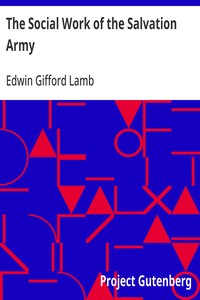
Before opening The Social Work of the Salvation Army — Context and Discussion, the edition data offers a quick orientation: 45,367 words, 3 hr 18 min estimated reading time, and 6 detected text sections.
The text analysis averages about 13.7 words per sentence, while the detected sections provide another way to judge how the source is divided.
Project Gutenberg metadata also associates the work with “Salvation Army,” connecting these edition facts with the source record’s subject description.
Explore this collection
These alternatives are selected using recorded categories and estimated reading time.
About 182 minutes
Customs Everyday Life
41,841 recorded words. 16 minutes difference from this book's estimate.
View Gutenberg source #40197About 236 minutes
Customs Everyday Life
54,166 recorded words. 38 minutes difference from this book's estimate.
View Gutenberg source #69529About 248 minutes
Customs Everyday Life
56,917 recorded words. 50 minutes difference from this book's estimate.
View Gutenberg source #65605Search stored excerpts and compare books → Choose by your preferences →
Choices use stored catalog measurements. Estimates vary with reading speed. A shared category is a catalog label, not a claim that two books have the same argument or literary quality.
Search reads excerpt text stored with this catalog and links to its associated Gutenberg record. The connection is stored in the site database; this tool does not recheck that every excerpt is word-for-word identical to that external record. Excerpt search does not cover every chapter and does not verify historical publication dates.
Catalog snapshot checked: 2026-09-25. Coverage: 100 public books, 100 available source excerpts.
Calculated from edition completeness, EPUB availability, text structure and catalogue metadata. Not a user rating.
Total of 100 points, scaled to a 2.5-5.0 range. Editions with an empty description or a missing EPUB file are not scored.
Public-domain source text
The source text is kept in the dedicated reader, separate from this catalogue record and its commentary.
Edwin Gifford Lamb opens his 1909 doctoral dissertation with a deliberate boundary: he will describe the Salvation Army's social machinery, not its religious message. Drawing on personal visits to Army institutions across the United States and England, Lamb slept in its hotels, worked in its industrial homes, and walked its farm colonies. The result is a field study grounded in observation rather than doctrine.
The book's most striking evidence comes from case records. Lamb transcribes fourteen inmate profiles from a New York City hotel, each a compressed biography of unemployment, family loss, and intermittent charity. These sketches—numbered, never named—form a quiet census of the urban poor at the turn of the century.
Lamb insists on separating the Army's social work from its spiritual mission, a distinction he borrows from Commander Booth-Tucker's description of the Army as 'the evolution of two great ideas.' The preface makes clear that this is a doctoral thesis in political science, not a promotional pamphlet. Lamb gathered data 'from personal observation' rather than from books, which he notes are scarce. He visited institutions in New York, Ohio, Colorado, California, and London, including the farm colony at Hadleigh. His method—sleeping in Army hotels, working in industrial homes, mingling with inmates—gives the study an ethnographic texture rare in early twentieth-century social research.
The most arresting section reproduces case histories of men staying at a Salvation Army hotel. Each entry follows a pattern: birthplace, age, trade, family ties, work history, drinking habits, and appearance. The men range from a twenty-two-year-old Massachusetts mill worker who 'had never been hungry or without a bed' to a thirty-two-year-old English-born painter who 'looked dissipated and unreliable.' Lamb records their own words—'claimed to be a Mason,' 'said he drank when he got the chance'—without moralizing. The cumulative effect is a stark taxonomy of poverty: broken families, seasonal labor, jail stays, and the recurring phrase 'walked the streets all night.'
Lamb's chapter structure maps the Army's social apparatus: industrial departments, hotels and lodging houses, farm colonies, slum work, rescue work, and minor features. The industrial homes functioned as labor exchanges and workshops; the hotels offered cheap beds and meals; the farm colonies aimed to resettle urban men on the land. Lamb's visit to Hadleigh, thirty miles from London, suggests the scale of these experiments. Yet the case records complicate any simple narrative of uplift. Many men 'had never worked in the country' or showed 'lack of initiative and intelligence.' Lamb does not resolve these tensions—he presents them as data.
Lamb's study is valuable less for its conclusions than for its documentary method. The case histories, the institutional descriptions, and the author's willingness to work alongside the men he studied offer a rare ground-level view of Progressive Era charity. Readers interested in the history of social work, urban poverty, or the Salvation Army itself will find here not a celebration but a careful inventory—one that lets the subjects speak, however briefly, for themselves.
That rainy afternoon, Lamb’s careful records of the poor in Salvation Army shelters felt less like statistics and more like patient listening. The same hush followed me later, when I stumbled upon The Book of Vagabonds and Beggars, with a Vocabulary of Their Language — Text and Context, its old cant terms whispering the same stubborn dignity from another century.
Capture what you thought, learned, and would like to remember.