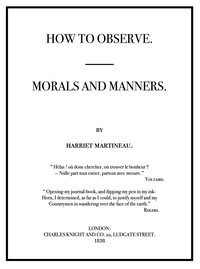
Harriet Martineau opens How to Observe: Morals and Manners with an epigraph from Voltaire and a quotation from Rogers, signaling her Enlightenment-influenced, empirical approach. The book is the second in a series originally conceived by the Society for the Diffusion of Useful Knowledge, and Martineau wastes no time in establishing that observation is a skill to be taught, not a passive act. She insists that the traveler must be equipped with philosophical, moral, and mechanical requisites before setting out—a framework that structures the entire first part of the work.
The Observer's Toolkit: Philosophy, Morals, Mechanics
Martineau divides the prerequisites for observation into three categories: philosophical, moral, and mechanical. The philosophical requisites include a clear understanding of what constitutes evidence and a resistance to prejudice. She warns that “it is full as easy to miss truth as to find it,” a maxim that underpins her entire method. The moral requisites demand that the observer cultivate sympathy without sentimentality, and the mechanical requisites cover practical matters such as note-taking and classification. This tripartite structure is itself a statement about the rigor Martineau expects: observation is neither innate nor casual but a disciplined practice.
Reading Prisons and Punishments as Social Texts
In the chapter on the treatment of the guilty, Martineau offers a nuanced analysis of what prisons reveal—and conceal—about a society. She cautions that under a despotism, prisons reflect only the morals of rulers, not the people. The example of the Burmese king who “spread out” his prime minister in the sun is juxtaposed with the creditor’s similar treatment of a debtor’s family, showing that cruelty can permeate a society even when it originates with the powerful. Under representative governments, however, prisons become a “test of the feelings of the majority.” Martineau praises the Philadelphia penitentiary as a sign of “thoughtful and laborious humanity” while noting that Newgate persists not from cruelty but from “ignorance” or “apathy.” The observer must therefore ask whether reform has begun and whether public sentiment is moving.
Epitaphs, Songs, and the Voice of the People
Martineau directs the traveler to seemingly minor cultural artifacts as key indicators of moral notions. Epitaphs, for instance, reveal what a society values in the dead—and by extension, in the living. Popular songs are another rich vein: they express “character of prevalent pride” and the “character of popular idols.” The talk of aged people and children, too, offers unfiltered evidence of a society’s deepest assumptions. Martineau’s method is consistently comparative: she urges the observer to note what is praised, what is ridiculed, and what is passed over in silence. These small details, she argues, are more reliable than formal declarations of principle.
The Limits of Inference: A Cautious Empiricism
Throughout the text, Martineau repeatedly warns against over-interpretation. She notes that the degree of reliance on “brute force and upon public opinion” is not always proportional to a society’s apparent civilization. The traveler must distinguish between what a government does and what a people would choose. In Austria, she writes, it would be “harsh to suppose that subjects have any desire to treat one another as the Emperor and his minister treat political offenders.” This caution extends to all domains: a single prison, a single song, a single epitaph cannot stand for the whole. Martineau’s method is cumulative, demanding multiple, cross-checked observations before any conclusion is drawn.
Martineau’s handbook is less a travel guide than a manual for critical thinking. Readers will find that her advice applies as much to reading newspapers or evaluating public discourse today as it did to the nineteenth-century traveler. The book rewards those who approach it as a set of tools to be adapted, not a checklist to be followed. Her insistence on evidence, her wariness of easy generalizations, and her faith in the power of systematic inquiry make this a surprisingly modern work.
That rainy afternoon, Martineau’s insistence on reading epitaphs as collective confession kept me company, and I found myself wondering what a village’s tombstones would say about my own neighbours. Then, almost by accident, the next shelf yielded The fields of France — Story, Setting & Ideas, and the same quiet curiosity seemed to wander through its pages, like a lantern carried too gently to startle anything.