About 403 minutes
Woman's Life in Colonial Days — Reading Notes
Anthropology
92,674 recorded words. 31 minutes difference from this book's estimate.
View Gutenberg source #15488
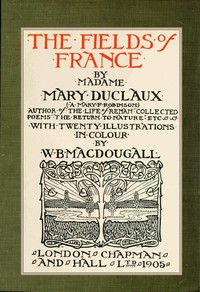
For The fields of France — Story, Setting & Ideas, the stored edition analysis reports 85,419 words, 6 hr 12 min estimated reading time, and 11 detected text sections.
The text analysis averages about 25.1 words per sentence, while the detected sections provide another way to judge how the source is divided.
Project Gutenberg metadata also associates the work with “France -- Social life and customs,” connecting these edition facts with the source record’s subject description.
Explore this collection
These alternatives are selected using recorded categories and estimated reading time.
About 403 minutes
Anthropology
92,674 recorded words. 31 minutes difference from this book's estimate.
View Gutenberg source #15488About 304 minutes
Anthropology
69,884 recorded words. 68 minutes difference from this book's estimate.
View Gutenberg source #33944About 492 minutes
Anthropology
113,029 recorded words. 120 minutes difference from this book's estimate.
View Gutenberg source #20411Search stored excerpts and compare books → Choose by your preferences →
Choices use stored catalog measurements. Estimates vary with reading speed. A shared category is a catalog label, not a claim that two books have the same argument or literary quality.
Search reads excerpt text stored with this catalog and links to its associated Gutenberg record. The connection is stored in the site database; this tool does not recheck that every excerpt is word-for-word identical to that external record. Excerpt search does not cover every chapter and does not verify historical publication dates.
Catalog snapshot checked: 2026-09-25. Coverage: 100 public books, 100 available source excerpts.
Calculated from edition completeness, EPUB availability, text structure and catalogue metadata. Not a user rating.
Total of 100 points, scaled to a 2.5-5.0 range. Editions with an empty description or a missing EPUB file are not scored.
Public-domain source text
The source text is kept in the dedicated reader, separate from this catalogue record and its commentary.
The book opens with a precise geological description of the Cantal region, grounding the reader in the volcanic origins of the landscape: the Puy Mary, the ash-grey cone of Puy de Griou, and the radiating valleys carved by rivers. This attention to the physical formation of the land sets the pattern for the entire work—each chapter begins with a specific place and builds outward, linking terrain to human activity. The author’s voice is immediate and personal, yet anchored in observation: she notes the basalt floor of the plateau, the beech woods, and the altitude of the hillside behind her house. This is not a travelogue of impressions but a study of how geology shapes agriculture, settlement, and even the character of the people.
The first chapter, “A Farm in the Cantal,” establishes a method that recurs throughout: start with the physical structure of the land, then move to the human structures upon it. The farm at Olmet is described not in isolation but as part of a volcanic system—the long-dead lava, the river Cère, the wooded gorges. The author’s eye for detail is evident in her description of the hillside: green pastures at the base, a cornice of fluted rocks above, and serried beech woods on the breast. She climbs to Les Huttes on the plateau and sees the valley as a cañon sunk between two high table-lands. This layered approach—geology, then agriculture, then daily life—gives the reader a sense of how the farm is embedded in its environment.
In “A Manor in Touraine,” the focus shifts from volcanic highlands to the gentler valleys of the Loire. Here the author examines the relationship between the manor house and its surrounding fields, noting how the architecture reflects the social order. The chapter contrasts the rugged self-sufficiency of the Cantal farm with the more refined, hierarchical world of the Touraine estate. The author’s observations are precise: she notes the placement of the manor relative to the river, the arrangement of outbuildings, and the patterns of cultivation. The landscape is not merely scenic but functional, shaped by centuries of use. The reader gains a sense of how different regions of France produce different ways of life, each with its own rhythm and logic.
The chapter “The Forests of the Oise” moves to a different climate and topography. The author describes the “windy plains of Valois” and the “lean, chill, flat” beauty of the region, comparing it to a thin thirteenth-century saint. She catalogs the remnant forests—Chantilly, Coye, Compiègne, Hallatte, Villers-Cotterets—as “a collar of green emeralds upon the breast of Mother Earth.” The prose becomes more lyrical here, but it remains grounded in specific detail: the acacia trees that served as fodder during the parched spring of 1893, the view from the Montagne de la Verberie with the Oise lying “like a scimitar of silver.” The author’s movement through the landscape is deliberate, from Senlis to the forest outskirts, noting the transition from cleared fields to deep woods.
The later chapters turn to historical subjects: “How the Poor Lived in the Fourteenth Century” and “The Mediæval Country House.” The author uses architectural and documentary evidence to reconstruct past lives, but she never loses sight of the present landscape. In Senlis, she observes the spring cleaning of the cathedral, with a char-man suspended in a crate brushing cobwebs from sculptured capitals—a scene that bridges medieval craftsmanship and modern maintenance. The chapter on the medieval country house examines the layout of manors and farms, connecting them to the contemporary structures described earlier. This historical turn enriches the reader’s understanding of the fields and buildings seen in previous chapters, showing how they are products of long social and economic processes.
Throughout The Fields of France, the author maintains a dual focus: the physical reality of the land and the human activities that have shaped it. She moves from volcanic peaks to river valleys, from medieval cathedrals to modern farms, always attentive to the interplay of geology, agriculture, and architecture. Readers interested in French regional life, landscape history, or the essay form will find here a work that rewards careful reading. The illustrations by W. B. Macdougall complement the text, but the prose itself is vivid enough to stand alone.
There’s a moment in The Fields of France where the author traces how a Cantal farm’s stone walls fold into the hillside, and I found myself thinking about how belief systems, too, are built from local materials. The Witch-cult in Western Europe: A Study in Anthropology — Inside the Classic feels like an older, stranger map of that same earth-bound logic—not history as abstraction, but something you can almost touch, the way a path remembers the foot that wore it down.
Build a private reading journal entry for this title.