About 177 minutes
Workhouse Characters, and other sketches of the life of the poor. — Themes and Context
Anthropology
40,600 recorded words. 10 minutes difference from this book's estimate.
View Gutenberg source #40881
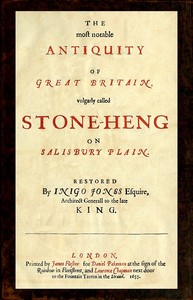
For The most notable Antiquity of Great Britain, vulgarly called Stone-Heng, on Salisbury Plain Restored by Inigo Jones Esquire, Architect Generall to the late King — Reading Notes, the stored edition analysis reports 38,288 words, 2 hr 47 min estimated reading time, and 8 detected text sections.
The text analysis averages about 30.9 words per sentence, while the detected sections provide another way to judge how the source is divided.
Project Gutenberg metadata also associates the work with “Megalithic monuments -- England -- Wiltshire -- Early works to 1800,” connecting these edition facts with the source record’s subject description.
Explore this collection
These alternatives are selected using recorded categories and estimated reading time.
About 177 minutes
Anthropology
40,600 recorded words. 10 minutes difference from this book's estimate.
View Gutenberg source #40881About 133 minutes
Anthropology
30,435 recorded words. 34 minutes difference from this book's estimate.
View Gutenberg source #35511About 238 minutes
Anthropology
54,618 recorded words. 71 minutes difference from this book's estimate.
View Gutenberg source #35234Search stored excerpts and compare books → Choose by your preferences →
Choices use stored catalog measurements. Estimates vary with reading speed. A shared category is a catalog label, not a claim that two books have the same argument or literary quality.
Search reads excerpt text stored with this catalog and links to its associated Gutenberg record. The connection is stored in the site database; this tool does not recheck that every excerpt is word-for-word identical to that external record. Excerpt search does not cover every chapter and does not verify historical publication dates.
Catalog snapshot checked: 2026-09-25. Coverage: 100 public books, 100 available source excerpts.
Calculated from edition completeness, EPUB availability, text structure and catalogue metadata. Not a user rating.
Total of 100 points, scaled to a 2.5-5.0 range. Editions with an empty description or a missing EPUB file are not scored.
Public-domain source text
The source text is kept in the dedicated reader, separate from this catalogue record and its commentary.
Inigo Jones's The most notable Antiquity of Great Britain, vulgarly called Stone-Heng (1655) opens with an engraved portrait of the architect, then a dedication and a preface by editor John Webb. The work is not a straightforward description but a polemical restoration: Jones aims to prove Stonehenge a Roman temple, not a British or Danish monument. The text moves from personal narrative—Jones's youthful studies in Italy—to a systematic refutation of rival theories, using classical sources and architectural principles.
John Webb's preface presents the treatise as moulded from Jones's 'indigested notes,' a claim that shapes how the reader receives the argument. The frontispiece portrait by Wenceslaus Hollar, after Van Dyck, establishes Jones as the 'Vitruvius of his age.' This visual authority precedes the text, reinforcing the idea that Stonehenge's true meaning requires an architect's eye. The dedication to Philip Earl of Pembroke further situates the work within a network of patronage and antiquarian interest.
Jones organizes his argument by dismantling earlier theories. He moves methodically through claims by 'Anonymus' and others, using historical sources like Tacitus to counter each point. For instance, he rejects the idea that Stonehenge was Boadicia's tomb by arguing that Romans would not permit a monument to a conquered enemy. The structure is cumulative: each refutation builds toward his own conclusion. The text's movement between ancient authors and contemporary observation creates a layered, scholarly rhythm.
Jones repeatedly contrasts decay with restoration. He describes searching out 'ruines of those ancient Buildings' in Italy, then applying that knowledge to Stonehenge. The monument itself is called 'orderly irregular, and formlesse uniform,' a paradox that captures its puzzling geometry. Hollar's engravings—though not excerpted here—would have visually reinforced this tension between disorder and design. The language of 'restoring' Stonehenge to its original form pervades the treatise, framing the work as an act of architectural recovery.
The narrative shifts from Jones's Italian travels to the Salisbury Plain, then to ancient Rome via textual citations. This geographical and temporal movement mirrors the argument's logic: classical principles from Italy are applied to a British monument. The text also moves between scales—from the 'whole imperiall Eagles' of Rome to the specific stones of Stonehenge. This constant shifting keeps the reader aware of multiple contexts, reinforcing Jones's claim that only a trained architect could bridge these worlds.
Jones leans heavily on Roman historians, especially Tacitus, to support his case. He quotes Tacitus on Petronius Turpilianus's governorship, arguing that the Britons were too uncivilized to build Stonehenge. The text weaves Latin phrases into English prose, signaling erudition. This reliance on classical texts, however, also limits the argument: Jones infers from silence and interprets ambiguous passages to fit his thesis. The reader must weigh the evidence presented against the possibility of alternative readings.
Readers should attend to how Jones's architectural training shapes his method: he treats Stonehenge as a building to be read, not a relic to be wondered at. The interplay between text and image—Hollar's engravings and Jones's prose—invites scrutiny of how visual evidence supports or complicates the argument. This edition preserves a pivotal moment in antiquarian thought, where Renaissance humanism meets British fieldwork.
Years among the stacks taught me that Inigo Jones sought to civilize Stonehenge’s ancient mysteries, to pin them beneath Roman order. Yet the old stones kept their secrets, much like the witch-cult Margaret Murray traced, a shadow of older faith beneath accepted history. Both books whisper that what we label savage or superstitious often holds a deeper, quieter truth. The Witch-cult in Western Europe: A Study in Anthropology — Inside the Classic feels like a familiar neighbor to Jones’s grand theory—each, in its own way, a careful hand resting on a door best left ajar. I think of them as companions atop my shelf, arguing gently across the years.
Build a private reading journal entry for this title.