About 403 minutes
Woman's Life in Colonial Days — Reading Notes
Anthropology
92,674 recorded words. 89 minutes difference from this book's estimate.
View Gutenberg source #15488
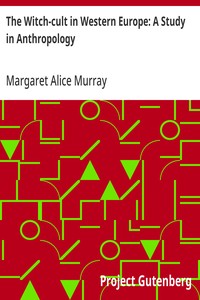
The source record for The Witch-cult in Western Europe: A Study in Anthropology — Inside the Classic measures this digital text at 113,029 words, 8 hr 12 min estimated reading time, and 20 detected text sections.
The text analysis averages about 17.0 words per sentence, while the detected sections provide another way to judge how the source is divided.
Project Gutenberg metadata also associates the work with “Ethnology,” connecting these edition facts with the source record’s subject description.
Explore this collection
These alternatives are selected using recorded categories and estimated reading time.
About 403 minutes
Anthropology
92,674 recorded words. 89 minutes difference from this book's estimate.
View Gutenberg source #15488About 372 minutes
Anthropology
85,419 recorded words. 120 minutes difference from this book's estimate.
View Gutenberg source #70768About 304 minutes
Anthropology
69,884 recorded words. 188 minutes difference from this book's estimate.
View Gutenberg source #33944Search stored excerpts and compare books → Choose by your preferences →
Choices use stored catalog measurements. Estimates vary with reading speed. A shared category is a catalog label, not a claim that two books have the same argument or literary quality.
Search reads excerpt text stored with this catalog and links to its associated Gutenberg record. The connection is stored in the site database; this tool does not recheck that every excerpt is word-for-word identical to that external record. Excerpt search does not cover every chapter and does not verify historical publication dates.
Catalog snapshot checked: 2026-09-25. Coverage: 100 public books, 100 available source excerpts.
Calculated from edition completeness, EPUB availability, text structure and catalogue metadata. Not a user rating.
Total of 100 points, scaled to a 2.5-5.0 range. Editions with an empty description or a missing EPUB file are not scored.
Public-domain source text
The source text is kept in the dedicated reader, separate from this catalogue record and its commentary.
Margaret Murray's study opens with a methodological claim: she will treat the judicial records and contemporary chronicles as primary sources, studying 'their facts and not their opinions.' This forensic approach shapes the entire work, as she pieces together the cult's structure from depositions given under interrogation. The excerpts reveal a persistent attention to the precise wording of spells, oaths, and invocations—phrases such as 'Horse and hattock, in the Divellis name' or 'Har, har, Hou, Hou, danse ici'—which Murray treats as evidence of a coherent ritual language across regions.
Murray devotes considerable space to cataloguing the verbal formulas used by accused witches, treating them as fragments of a lost liturgy. The excerpts include a Basque spell invoking 'Janicot,' a Guernsey chant calling on 'Hou,' and the Somerset witches' parting cry 'Rentum tormentum.' She notes that these words often accompanied specific actions—applying flying ointment, crossing water, or transforming into animals. The rhyme for becoming a hare, 'I sall goe intill ane haire, / With sorrow, and sych, and meikle caire,' is given in full, showing a consistent metrical structure. Murray does not speculate on the origins of these phrases beyond noting their connection to named deities, but her method implies that the survival of such formulas across trials indicates a shared cultic vocabulary.
The chapter on 'The God' (Chapter II) is organized into four subsections: 'As God,' 'As a Human Being,' 'Identification,' and 'As an Animal.' From the table of contents alone, it is clear that Murray treats the deity not as a single figure but as a role that could be embodied by a human leader or represented by an animal. The excerpts do not include the full argument, but the structure suggests a comparative approach: the god appears in multiple forms, and the cult's rituals—such as the 'kiss of shame' or the 'Devil's mark'—serve to bind the worshipper to this entity. Murray's reliance on trial testimony means that the god's nature is inferred from what witnesses claimed to have seen or done, rather than from theological texts.
The excerpts reveal a work that moves slowly, building its case through the accumulation of specific instances. A single paragraph may cite multiple trials: Isobel Gowdie (1662), Martin Tulouff (1563), and the Somerset witches (1664) are all brought together to illustrate magic words. This method creates a dense, repetitive texture that can feel exhaustive but also risks monotony. Murray's prose is plain and declarative, rarely pausing for reflection. The effect is that of a legal brief: each fact is a piece of evidence, and the reader must follow the chain of citations. The pace is deliberate, suited to a reader willing to trace the connections between Scottish, French, and English sources.
Readers should approach Murray's text as a work of historical reconstruction rather than a narrative. The trial records are quoted at length, and the author's interpretations are often embedded in the arrangement of evidence. Pay attention to the footnotes and the way she groups testimonies by theme—this is where her argument takes shape. The book rewards those who read slowly, following the threads of language and ritual across different regions and decades.
Reading Murray’s accounts of trial records, I kept thinking how little we hear the accused speak. It’s the same quiet ache I felt with The Pagan Tribes of Borneo A Description of Their Physical Moral and Intellectual Condition, with Some Discussion of Their Ethnic Relations — Reading Notes—both books, in their dated earnestness, are doors left slightly ajar. We peer in, but the ceremony, the true belief, stays just beyond the legal parchment and measured prose.
A brief reflection can help important ideas stay with you longer.